


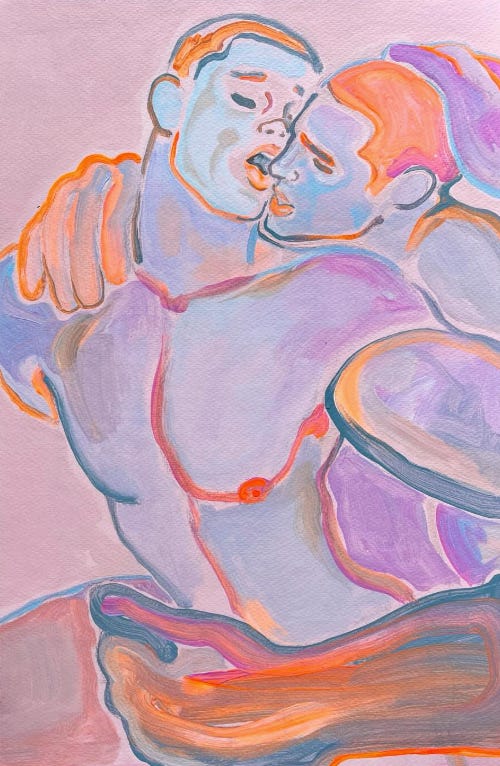
One of the shock effects of the COVID Era was on memory. My timeline melted, what was hardly reliable became unmoored; yet one magical evening stays in my mind with all of its edges. After receiving my vaccine booster (Team Pfizer, that good jab, with the microchip) the very same day the City called in my cohort (the 50+ crowd) I skipped out of the hospital and made a beeline for the Central Park Ramble. That booster made me feel invincible after being cooped up (and hard up) for so long. I wanted to breathe fresh air and revisit my old stomping grounds, even if just for a nostalgia trip. The Ramble was hands down my favorite analog cruising spot, back before the Internet and mobile apps: outdoors, wooded, romantic. It attracted New Yorkers and visitors alike from far and wide. Hanging out there made me feel connected to our historic inhabitation of landscape architect Frederick Olmstead’s romantic vision of a “wild garden.” I didn’t expect much action in the garden that spring evening in 2020; it was drizzling, and the days when you could easily find trade were long behind us.
In his research for Gay New York, historian George Chauncey found references going back to the Nineteen-twenties that the lawn north of the Ramble—where I cruised sporadically in my youth—was so popular that it was nicknamed “the Fruited Plain.” Tempering this colorful history is the reason gay men sought each other out in such spaces: we were outlaws and pariahs, facing the real dangers of exposure, arrest, violence. In my cruising prime, the long-running scene in the Ramble would be disrupted, first by the AIDS crisis and later by over-policing. Those disruptions preceded the advent of websites such as Manhunt and Dudesnude, and locative apps like Grindr, which launched in 2009 and heralded a new era of GPS-enabled hook-ups. These were the fallow years when IRL cruising in the Ramble (and elsewhere) was a shadow of years past.
Scurrying into the Ramble, band-aid over my fresh jab, I was in for a surprise: it was teeming with horny men. The drizzle just meant that there weren’t many civilians around and the place was all ours. I wandered along the paths, taking in the petrichor, until the magic hour came and the cast-iron luminaires turned on. The old knowledge kicked back in: hard stares were thrown, shuffling feet did circling dances in the dirt, heads nodded towards secluded spots. I was unleashed, joining huddles of likeminded guys, now and then sparking with a co-conspirator and luring him into a nearby lair. The overall vibe among the horde was purposeful horniness with a care-taking edge. We were all in on best practices: people had their boundaries about mask-wearing or getting too close, and they were fully respected. I get that this wasn’t the most medically sound decision, but my mind was alive with possibility and ripe with delusion: I am testing out this booster for science. It wouldn’t be my the first time clinging to delusions through an epidemic; after dodging AIDS in the Eighties, I’d at some point convinced myself that I was immune due to some obscure bloodline on my father’s side.
I’d never encountered such uniformity as this crowd’s approach to cruising. It was weirdly organized, as if everyone was operating with the same rulebook. Part of the excitement and danger of cruising was you never knew where someone else might be coming from. They might have very different rules of engagement than you.You might have found that down-low baddie very loving and sweet when you were alone with him, but he won’t acknowledge you in front of others. You might have found yourself in a chokehold, not sure whether he was rough trade or you were about to get mugged.
We’ll always come up with new ways to connect, whatever the circumstances: a pandemic, increased online scrutiny, the current reactionary thrall. It’s in our code; we need to evolve our strategies for finding one another.
It turns out that on that magical night, the Ramblers were all operating with the same rulebook. The guys I met were part of a larger meet-up organized on Sniffies, then a recent entrant into the gay locative apps space, with a focus on cruising locations. I’d stumbled upon a pandemic-era return to outdoor cruising, pre-arranged, app-mediated. I could tally up a few factors contributing to this hybrid digital/analog resurgence.The police—who not too long ago heavily patrolled these grounds—had lately been busy with regular protests against their violence in the wake of George Floyd’s killing, and pandemic-related matters. A harm reduction case could be made for outdoor sex over sex in confined spaces. If my own weary eyes were any indicator, we survivors were just entirely burnt out on screen time.
In truth, I’d experimented with pandemic hook-up strategies before (Okay so I hadn’t been that hard up, but sexual frustration was airborne). Out in Cherry Grove in the summer of ’20 (pre-vaccine) I’d crept into the Meat Rack on another drizzly night. I watched on my phone screen as the guy from the Pines who I’d arranged to meet via Grindr got closer: 2,096 feet away, 809 feet away, 373 feet away. Good old English system of measure, it felt correct to calculate our distance in feet, since our feet were changing that distance. I stumbled along in the swale—the sand not yet wet enough that it didn’t shift under foot—until I made it to our meeting spot. My trade was masked like me and wearing a hooded raincoat. After taking each other in from six feet apart, he turned around, lifted his raincoat over his head, and pulled down his track pants. I grabbed him by the neck and rutted in his well-lubed hole until we were both satisfied. Not my usual scene, but hot under the circumstances. Between the raincoat barrier and the outdoor setting, we were doing the most to not get COVID while getting a nut.
After the first phase of the vaccine rollout, I landed upon another harm-reductive hook-up strategy: a series of app-mediated encounters with a role-play enthusiast, a hairy stud in his thirties with a theater background and an incest fixation. By mutual agreement, I would enter his apartment, remaining masked, and find him on his knees. The dirty talk would start; he’d give ashamed replies to my goading. “Please don’t make me, dad…” he’d beg, using his improv class skills.“Take care of your old man, son,” I’d bark as I took my pleasure in his mouth and throat. My lines were muffled by the mask, but I was fully committed to the role. “Son” would ping me every now and then for masked scenes.
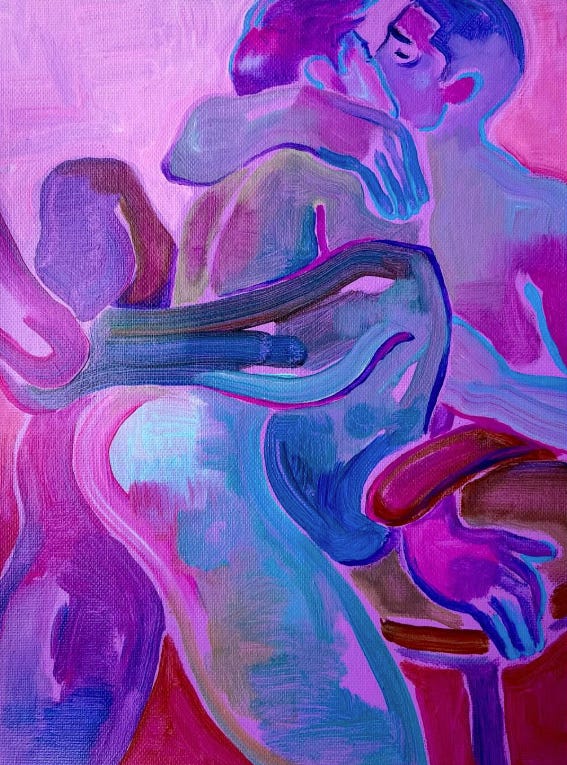
As COVID receded, I returned to the Ramble, usually at dusk, to find the same vibe. One of the guys I met confided in me about a channel on an encrypted app. Yasss, these children are tech savvy, I heard my inner gay voice squeal. The cruising I encountered was again largely mediated by digital means, either Sniffies or that encrypted channel. My nights in Central Park had that same semi-organized feel I’d first picked up on that boostered night. This is a new paradigm; the use of that encrypted channel suggests a return to the sexual underground of the Pre-Stonewall era. I noted that the cruising geographies in the Ramble had shifted towards the covert. The Peninsula, where cruisers once announced their arrival with a runway presentation—either a butch stomp or a sissy strut—was inactive, but a haunted clearing near Tupelo Field was swarming, giving me coven circle vibes. The digital children are treading their own paths.
From the outset, the digital realm has been driven by queer longing; it’s given us special abilities to find each other, though not without risks. Our still-vulnerable group gives over very intimate details to what are essentially data harvesting operations. There’s also the peril of the user experience: the mind-numbing, cybernetic slog of scrolling and swiping, face buried in screen, eyes burning. Analog cruising could also be pretty damn tedious: plenty of lost effort and missed connections, distracted emptiness and isolation. It wasn’t all sparks and fire, but at least you could meditate on the form of a tree, or spot a raccoon and her kits. I found the possibility of a hybrid digital/analog cruising mode encouraging, or as encouraging as anything could be during that slow-rolling cataclysm.
In his essay “Sex and Isolation,” Bruce Benderson characterizes the digital realm as “the polar opposite of the physical space called the marketplace, or downtown…smell and touch have been exiled from it.” I’d lamented the demise of IRL cruising as I even joined Early Majority users in AOL’s walled garden in 1996, leading to my transition to Manhunt and eventually the GPS-enabled apps. I’ve since marveled watching the COVID generation pick up on old patterns, which re-assert themselves in new forms in the “marketplace” known as the Ramble. It was like watching the gears of a restored mechanism restarting under the lamplight. For those of us who still had a sense of smell, the air was now ripe with pheromones. For those of us who dared to bare touch, the skin under our hyperactive finger pads was tender and electric.
During quiet moments in that naturalistic wood, I meditated on what all this says about our tribe: We’ll always come up with new ways to connect, whatever the circumstances: a pandemic, increased online scrutiny, the current reactionary thrall. It’s in our code; we need to evolve our strategies for finding one another. Leaning against a showy Black Tupelo, I summoned a mental image of its vast root system beneath the ground I stood upon. This need is at the root of queer resilience. We don’t have unbroken bloodlines, but we have other legacies to transmit, by other means. We bent GPS to meet our needs and reconnect with our analog selves. Our desires fused the scroll to the stroll. Our digital enablers may sniff at our habits and seek to turn us into their audience, but we’re not just another exploitable data set to monetize, our movements and proximities collected to know more about us to sell us more stuff. In the end and the beginning, beyond tech, beyond catastrophe, we are vectors of longing.
A Lambda Literary Fellow, Dale Corvino found his voice at the underground literary salon “Dean Johnson’s Reading for Filth,” recounting his youth as an object of longing and interactions with sex work. He’s published essays on Marilyn Monroe, Chilean writer/activist Pedro Lemebel, and queer longing in the digital era. BONDS & BOUNDARIES, his debut short story collection, was published in 2023 by Rebel Satori Press. His memoir, AFTERLIFE OF A KEPT BOY, won the C&R Press Nonfiction Prize and was released in 2025. He’s at work on his third book, a biography of gender warrior Dean Johnson. Find him on: Substack: https://substack.com/@dalecorvino, Threads: https://www.threads.com/dalecorvino, Instagram: https://www.instagram.com/dalecorvino
Cruising is a part of gay culture. I love how Amsterdam has acknowledged this by creating a legal cruising zone. There should be more of this!
the fruited plain! wonderful